The universe is expanding, but here’s the catch: it seems to be expanding at different rates depending on which direction we look. This discovery, confirmed by the James Webb Space Telescope and its predecessor, Hubble, raises an intriguing and fundamental question about our understanding of the cosmos. Is the model we’ve used to explain the universe’s expansion fundamentally flawed?
A Surprising Cosmological Tension
The phenomenon, known as the Hubble tension, has been a major puzzle for astronomers. In 2019, measurements from the Hubble Space Telescope revealed an unexpected discrepancy in the rate at which the universe is expanding. By 2023, the James Webb Telescope took these observations even further, providing more precise data that reinforced the initial findings. Together, these two cutting-edge instruments have ruled out any simple measurement error, as shown in a study published in Astrophysical Journal Letters. This isn’t just an oddity—it’s a challenge to our very understanding of the cosmos.
Professor Adam Riess, one of the study’s lead authors and a Nobel laureate in Physics, put it simply: “With the measurement errors ruled out, we’re left with the exciting possibility that we’ve misunderstood the universe.”
Two Methods, One Discrepancy
Scientists use two main approaches to measure the Hubble constant, the number that describes how fast the universe is expanding. The first method looks at the cosmic microwave background (CMB)—a faint glow left over from the Big Bang itself. Between 2009 and 2013, the European Space Agency’s Planck satellite estimated this constant at about 67 km/s/Mpc (kilometers per second per megaparsec).
The second approach uses Cepheid variable stars, whose fluctuating brightness allows astronomers to calculate distances between galaxies. This method gives a much higher value for the Hubble constant, about 74 km/s/Mpc, significantly different from the first measurement.
Repeated Confirmations
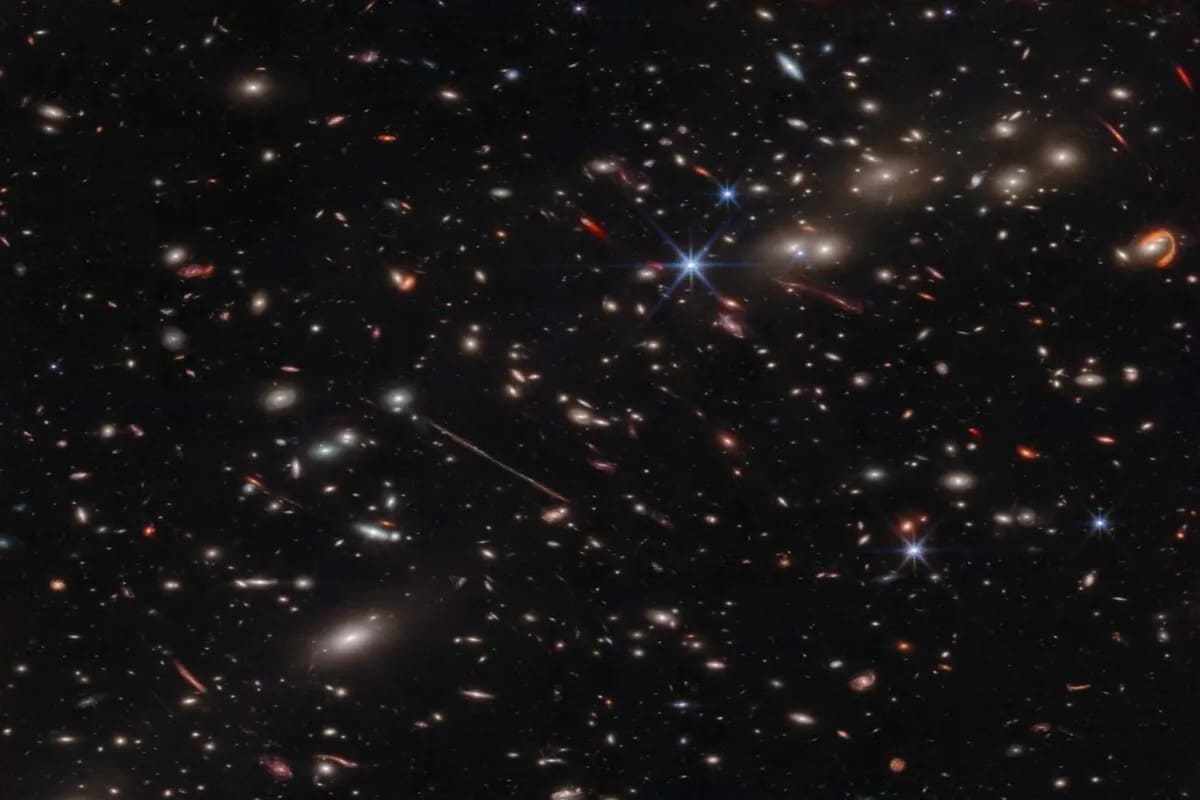
In 2023, researchers used the powerful capabilities of the James Webb Space Telescope to observe over 1,000 Cepheid stars in galaxies located 130 million light-years away. The data from Webb confirmed the higher value, reinforcing the discrepancy between the two measurement methods and excluding potential errors caused by confusing Cepheid stars with other types of stars.
Adam Riess commented, “The combination of Hubble and Webb’s data gives us the best of both worlds. We’ve confirmed that Hubble’s measurements remain reliable, even as we climb the cosmic ladder.”
A Game-Changer for Cosmology?
This ongoing Hubble tension could point to the existence of physics we don’t yet understand. Some theories suggest that the anomaly may be due to changes in dark energy, the mysterious force responsible for the accelerated expansion of the universe, or it could involve exotic particles that haven’t been detected yet.
For astronomers, this anomaly isn’t just a puzzle—it’s a pressing challenge. Nobel laureate David Gross summed it up: “This isn’t just a tension; it’s a crisis.”
As telescopes continue to gather more data, each new observation could either solve this mystery or uncover even deeper questions. One thing is clear: our understanding of the universe is evolving, and what we thought we knew may soon need to be rewritten. The universe, it seems, still has a few secrets left to reveal.