A recent scientific discovery is making waves in the field of paleontology, as a 500-million-year-old fossil challenges what we thought we knew about ancient life forms. The fossil of Helmetia expansa, first discovered in 1918, has just revealed new details that are reshaping our understanding of early arthropods from the Cambrian period. This newfound information is prompting a full reevaluation of this creature and its place in the evolutionary timeline.
Helmetia Expansa: A Misunderstood Ancestor of Trilobites
For over a century, Helmetia expansa was thought to be a primitive crustacean, a species that might have been a distant relative to modern-day marine creatures. However, recent studies have completely shifted this perception. Upon re-examining 36 specimens, scientists have found that Helmetia expansa is much more closely related to the early arthropods known as Conciliterga—a group that, like trilobites, played a pivotal role in the Cambrian explosion.
One of the key features that set Helmetia apart from other arthropods, and especially trilobites, is the lack of a calcified exoskeleton. This absence likely contributed to its poor preservation in fossil records, which is why it was often misunderstood in the past.
I remember reading about Helmetia expansa when I first encountered the fossil in a museum exhibit. At the time, I never imagined how much more could be hidden beneath its seemingly simple exterior. It’s a reminder that even what seems like a small discovery can lead to groundbreaking shifts in our understanding of the past.
Revealing a New Zoological Profile
The newly analyzed specimens of Helmetia expansa have uncovered a more complex morphology than scientists once believed. The fossil reveals an exoskeleton, a well-developed digestive system, and even fully-formed eyes. Its limbs were specially designed for movement on the ocean floor, a characteristic that highlights the advanced adaptations of this ancient arthropod.
This discovery is particularly important because it challenges the prevailing notion that many Cambrian fossils were structurally simple. By analyzing these new specimens, researchers are beginning to realize just how intricate early life forms were, long before the rise of more familiar species.
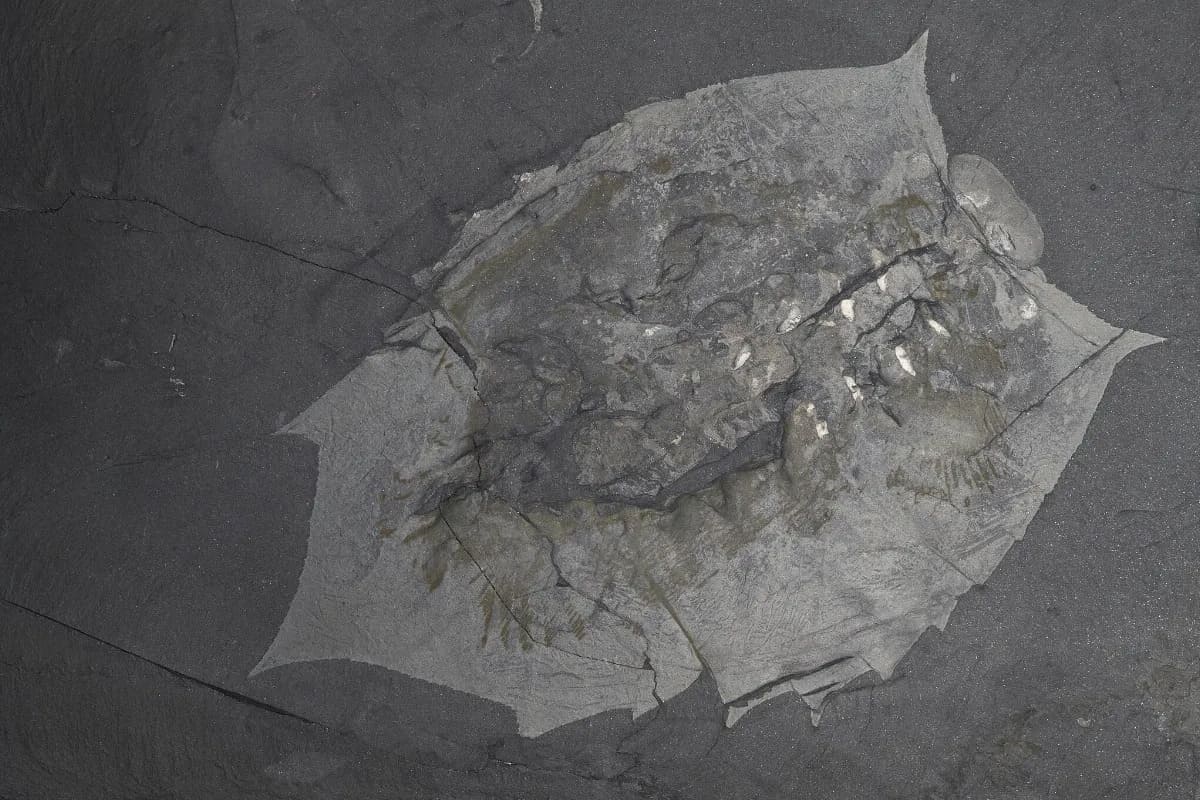
A Fossilized Shed Skin Tells a New Story
One of the most fascinating aspects of this discovery is the fossilized molt of a Helmetia specimen. This shed exoskeleton provides rare insight into the creature’s life cycle and behavior. The fact that this molt was preserved suggests that Helmetia expansa may have exhibited more advanced behaviors than initially assumed. The presence of such complex patterns hints at social or survival strategies, and it adds a layer of intrigue to our understanding of early animal life.
During my last visit to the paleontology section of the museum, I came across a display of this molt, and it struck me how a single, preserved relic could unlock so many new possibilities for understanding ancient behaviors. It’s as if that tiny fragment of the past carries echoes of the life it once represented.
Redefining Our View of Cambrian Fauna
Today, Helmetia expansa provides us with a fresh perspective on the biological diversity of the Cambrian period. This was a time marked by the rapid diversification of life forms, and Helmetia offers evidence of that variety, showing that arthropods had already begun to develop a wide range of adaptations long before the appearance of more familiar species like trilobites.
This discovery highlights the importance of revisiting old fossils with new technologies and approaches. By re-examining fossils that were once thought to be simple or insignificant, scientists are gaining a deeper understanding of the complexities of ancient ecosystems and evolutionary history.
A Testament to the Early Evolution of Arthropods
By reclassifying Helmetia expansa among the Conciliterga group, researchers are reinforcing the idea that arthropods had already begun to diversify during the Cambrian period. This finding sheds new light on the evolutionary relationships between different arthropod lineages, suggesting a much broader evolutionary spectrum than we previously understood.
As I read through the research papers, I was reminded of how scientific discovery often challenges our preconceptions. It’s always humbling to think that something as ancient as Helmetia could help us rethink the evolutionary paths of species that have long since disappeared.
Implications for Paleontologists
The reclassification of Helmetia expansa is a significant turning point for paleontologists, emphasizing the importance of studying multiple specimens before making conclusions. The newly analyzed 36 specimens show that every detail is crucial for accurately interpreting fossil records. This discovery encourages scientists to revisit and reconsider other fossils that may have been hastily classified in the past.
This reclassification offers an important lesson in scientific rigor. Much like in any field of research, we must be open to revisiting and refining our findings as new tools and insights become available. The process of challenging old assumptions leads to a more accurate understanding of the world, both ancient and modern.
Moving Toward a Deeper Understanding of Prehistoric Evolution
The Helmetia expansa fossil doesn’t just represent an ancient organism—it serves as a window into the mysteries of prehistoric evolution. As technological advances continue, discoveries like this enrich our understanding of life’s complexity, offering glimpses into the early stages of animal development. The insights from this fossil could prompt further re-evaluations of other ancient creatures, leading to new chapters in our understanding of the natural world.
Each new discovery, whether it’s a fossil or a molecular study, has the potential to rewrite history. As more and more ancient specimens are analyzed, who knows what other secrets will emerge from the past, waiting to transform our understanding of life on Earth.