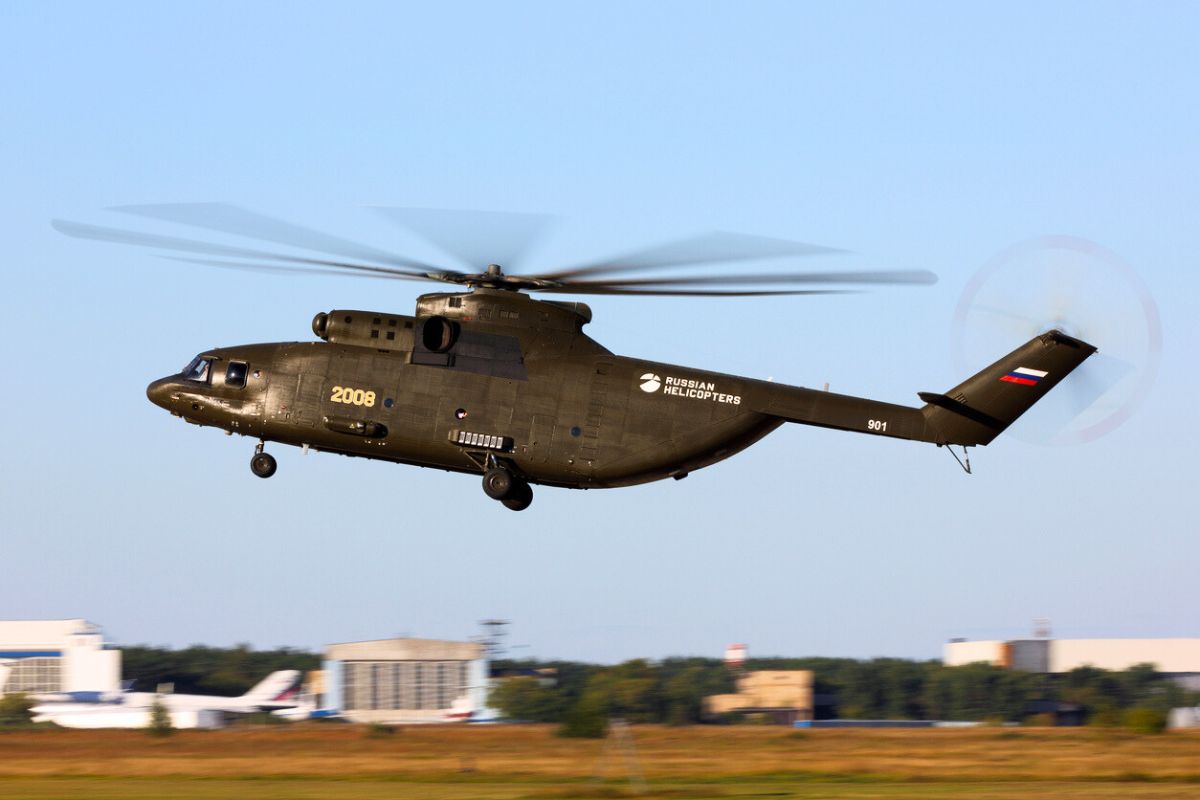
The Mil Mi-26, the largest helicopter ever built in mass production, continues to dominate the skies decades after its debut, cementing its place in aviation history.
Mil Mi-26: The Helicopter That Rules Them All
When it first took to the skies in the late 1970s, the Mil Mi-26 wasn’t just another military vehicle—it was a revolution. Developed during the Cold War, the helicopter quickly became the symbol of Soviet engineering, making waves in the world of aviation. Officially entering service in 1983, it was built to transport heavy military equipment, but its capabilities soon turned the heads of industries worldwide.
With nearly 11,400 horsepower from its eight rotors, the Mi-26 was already an aviation behemoth. But its true impact was felt not just in power, but in size. This monstrous helicopter is still unrivaled for its impressive build, able to carry up to 20 tons of cargo. It is an awe-inspiring piece of machinery that commands attention wherever it flies.
Defying Aeronautical Limits
For aviation enthusiasts and engineers, the Mil Mi-26 is a testament to the power of human innovation. The helicopter’s rotor diameter stretches to an incredible 32 meters, making it larger than many small passenger planes. Its length is nearly 36 meters, nearly on par with the size of certain commercial jets like those manufactured by Airbus.
In terms of weight, the Mi-26 holds the title as the heaviest helicopter ever built. It weighs 26 tons when empty, but once fully loaded, it can reach an astonishing 55 tons. Despite its size, it can still fly at impressive speeds, with a cruise speed of about 260 km/h and a top speed approaching 300 km/h. Watching videos of the Mi-26 in flight, it’s hard to imagine how such a massive craft can remain airborne, but the sheer power and efficiency of its engines are proof of its groundbreaking design.
The Mi-26’s ability to transport oversized loads has made it invaluable in military logistics, and it’s also been used for civilian tasks like disaster relief. Its versatility has allowed it to operate in remote areas where few other aircraft can manage, including during the Chernobyl disaster in 1986, where it was deployed for emergency missions.
How Many Mil Mi-26 Helicopters Were Built?
The Mi-26 is not confined to Russian skies alone; its utility has made it a global asset. Over 300 units of this helicopter have been produced, and they have been exported around the world. Countries across South America, Africa, and Asia have used the Mi-26 for both military and humanitarian purposes.
Its ability to carry up to several dozen people—whether soldiers, civilians, or disaster victims—has made it a reliable asset for countries in need of fast, large-scale transportation. It’s no surprise that the United Nations also used Mi-26 helicopters for humanitarian missions in the early 2000s.
The Mi-26, with its powerful capabilities and impressive size, remains a formidable part of global air fleets, and its longevity in operation speaks volumes about its design and utility.
Is the Mi-26 the Largest Helicopter in the World?
While the Mil Mi-26 is undoubtedly the largest mass-produced helicopter ever built, it’s not the absolute largest helicopter ever created. That title likely belongs to the Mil Mi-12, a Soviet prototype from the 1960s. The Mi-12 was equipped with two rotors and had an even larger size, but only two or three prototypes were ever built.
Though it was never mass-produced, the Mi-12 stands as an example of the Soviet Union’s desire to push the limits of aviation. It made a notable appearance at the Le Bourget Airshow in the 1970s, but despite its capabilities, the Mi-12 remained an experimental aircraft.
While the Mi-12 holds the “largest” title in terms of prototype size, the Mi-26 remains the reigning giant in terms of production, with its legacy solidified in both military and civilian use.
Global Impact of the Mi-26
As of today, the Mil Mi-26 continues to serve as a vital piece of military and humanitarian operations. Its size and ability to transport heavy and oversized cargo make it a go-to option for governments around the world, including in Algeria, India, Belarus, and even Cuba. Despite the development of new helicopters and drones, the Mi-26’s unmatched capacity ensures it remains in use.
The continuing operational life of the Mi-26 is a testament to its incredible engineering. While newer helicopters may surpass it in specific areas, nothing quite compares to its sheer power, versatility, and history. With its ability to carry massive loads, fly at high speeds, and operate in a variety of environments, the Mi-26 will remain a key player in the aviation world for years to come.
This massive helicopter stands as a symbol of Soviet innovation, and more than four decades after its creation, it continues to inspire awe across the skies, proving that some designs remain unrivaled in both time and scope.