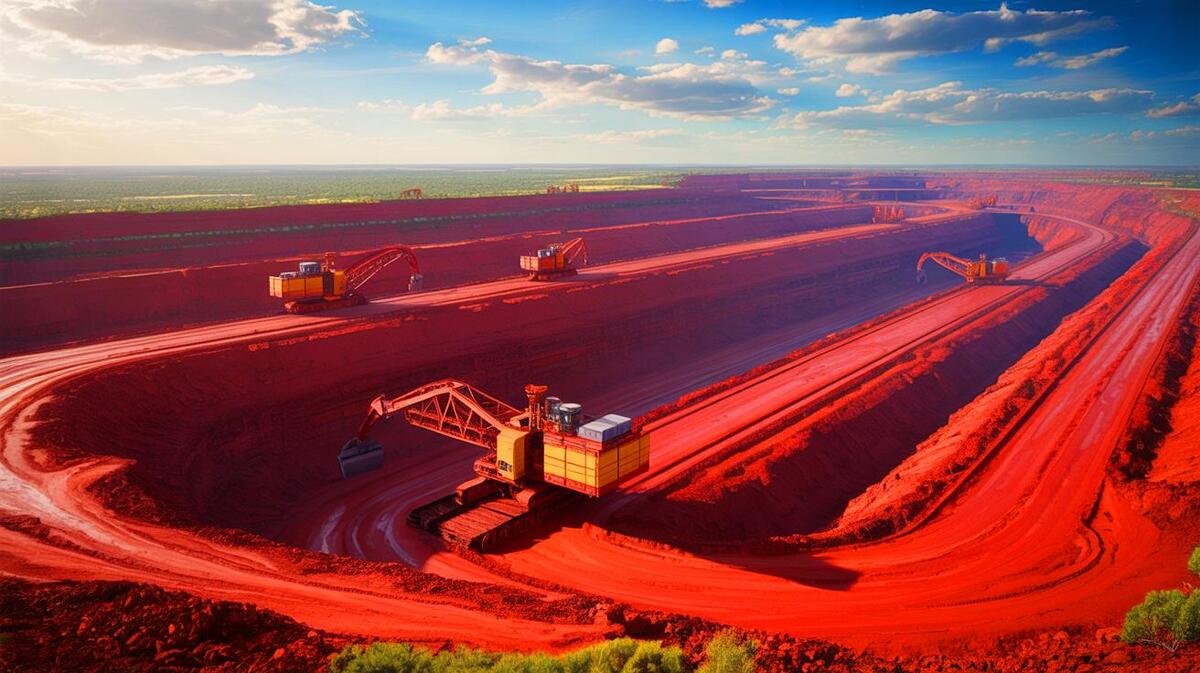
A colossal iron ore discovery in Western Australia’s remote Pilbara region—valued at nearly $6 trillion—is sending shockwaves through global markets and intensifying the strategic rivalry between the United States and China. With concentrations exceeding 60%, it’s one of the richest deposits ever found, promising to reshape trade flows, challenge scientific thinking, and potentially shift the balance of economic power.
Pilbara’s hidden treasure
Long celebrated for its mineral wealth, the Pilbara has once again seized the spotlight with the revelation of the largest iron deposit in recorded history. Located in the Hamersley Range, the find is forcing geologists to rethink the region’s formation.
New research has revised the age of these mineral-rich rocks from 2.2 billion years to around 1.4 billion years, suggesting that the shifting of ancient supercontinents created ideal conditions for the intense mineralisation now being unearthed. This shift in understanding not only rewrites parts of Earth’s geological story but also points to untapped potential in similar formations worldwide.
Technology reveals a game-changing deposit
The breakthrough came thanks to advanced isotopic dating and cutting-edge chemical analysis, which revealed far richer ore than previously estimated. Early surveys suggested around 30% iron content, but deeper investigation uncovered levels above 60%, ranking the deposit among the planet’s most lucrative.
Such technological precision promises not just more efficient mining, but also environmentally responsible extraction—reducing waste and setting new industry benchmarks. These tools could also spark a wave of exploration, uncovering other hidden reserves in remote and underexplored regions.
A geopolitical earthquake
Australia already dominates the global iron trade, but this find could solidify its position for decades. The sheer scale of the deposit is expected to influence iron ore prices and shift strategic relationships, particularly between countries heavily reliant on imports.
The discovery also raises the stakes in the ongoing US–China rivalry. China, the world’s largest iron consumer, has long sought to secure raw materials to fuel its industrial machine, while Washington is increasingly focused on securing strategic resources to counter Beijing’s influence. New trade alliances, long-term supply contracts, and even infrastructure investments could emerge as nations jostle for access.
Rewriting Earth’s history
Beyond economics, this find challenges deep-rooted geological theories. The conditions that produced such high-grade iron in the Pilbara may hold clues to similar deposits elsewhere—if researchers can decode the precise combination of tectonic shifts, sediment deposition, and mineral concentration that occurred over a billion years ago.
For scientists, it’s an unprecedented opportunity to study how supercontinent cycles have shaped not only landscapes but also the planet’s resource wealth.
This $6 trillion discovery is far more than a mining story. It’s a collision of science, economics, and geopolitics—one that could rewrite textbooks, redraw trade maps, and redefine how nations compete for the resources that underpin modern civilisation. And as experts point out, if this much iron has been hiding beneath Australia’s red earth, it begs the question: what else is still waiting to be found?