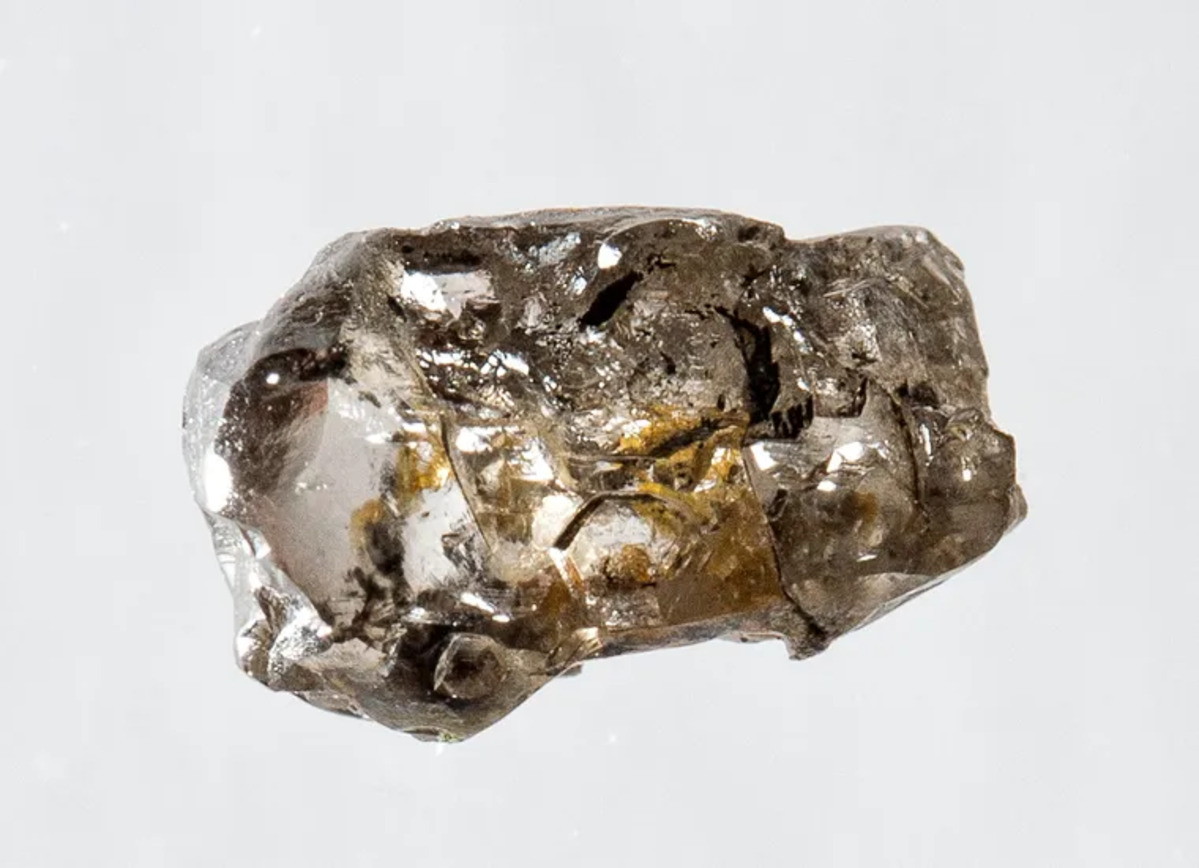
A rare diamond containing traces of a mineral known as ringwoodite has provided compelling evidence for an enormous water reservoir hundreds of kilometres beneath our feet—potentially holding the equivalent of one to two surface oceans.
A discovery that revives an old vision
Over 150 years ago, Jules Verne imagined vast, hidden oceans deep within the Earth. For decades, geologists dismissed the idea, believing that water could not survive the extreme pressure and temperature of the lower mantle. But in recent years, unique diamonds—nature’s time capsules—have challenged that assumption.
In 2009, a research team led by Dr. Graham Pearson from the University of Alberta uncovered a diamond from Brazil’s mantle transition zone, lying between 410 and 660 km below the surface. Unlike most diamonds, which form at around 150 km depth, this one contained a tiny inclusion of ringwoodite—a mineral previously seen only in meteorites or created in high-pressure lab experiments. Crucially, the ringwoodite was hydrated, containing about 1.4% of its weight in water molecules.
A second clue from deep beneath Botswana
The Brazilian find was extraordinary, but scientists needed another sample from a different location to confirm their theory. That confirmation came in 2022, when a team led by mineral physicist Tingting Gu discovered a similar diamond in Botswana’s Karowe mine. This second specimen strengthens the case for a globally present hydrated zone within the mantle’s transition layer.
If such hydration is indeed widespread, it would mean that Earth’s depths could hold a massive, solid-state water reservoir, locked within mineral structures.
Where did this deep water come from?
Two competing theories remain. It may be primordial water, trapped since Earth formed 4.5 billion years ago during the accretion of asteroid and meteorite material. Alternatively, it could be the result of subduction, a process in which oceanic crust is forced deep into the mantle, carrying water with it.
To solve the mystery, scientists plan to compare the hydrogen isotopic ratios of these deep minerals with those of meteorites and surface water, which could reveal whether the water originated from Earth’s formation or from surface recycling.
Why this hidden ocean matters
Dr. Gu believes this subterranean water could be a key part of a deep water cycle that helps regulate the planet’s geology, climate, and distribution of surface water. It may also influence volcanism and the physical and chemical properties of mantle rocks.
Dr. Pearson suggests another role: the water could weaken rock structures through hydrolytic weakening, a process that might explain deep-focus earthquakes occurring between 300 and 660 km below the surface.
Unlocking the Earth’s hidden systems
Studying these rare diamonds requires collaboration across seismology, mineral physics, and geochemistry. They offer a fleeting glimpse into a part of our planet humans will never visit, yet which may be crucial to its functioning.
As Dr. Gu reflects: “We humans are so small—we didn’t realise just how immense the Earth truly is.”