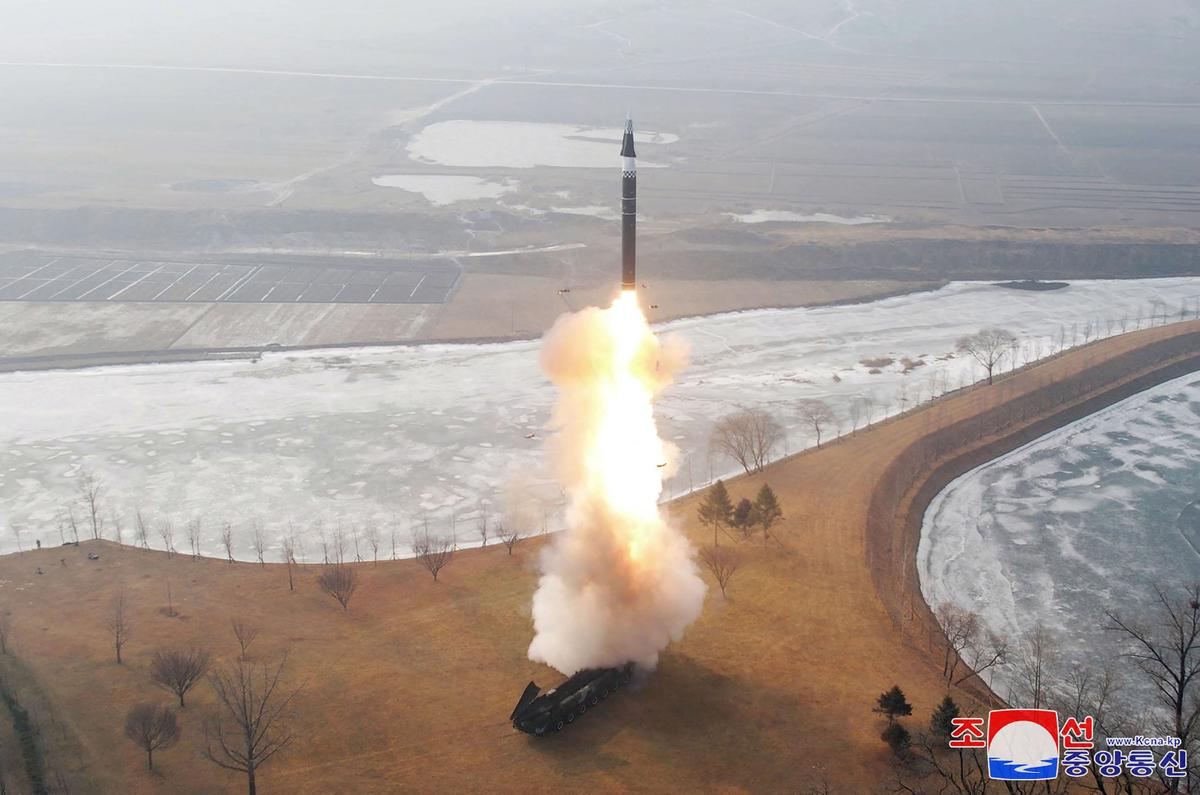
In a development that has raised fresh alarms across the Pacific region, North Korea has announced the successful launch of a new hypersonic missile—reportedly reaching twelve times the speed of sound and covering a distance of 1,500 kilometers. The timing, just weeks before Donald Trump is expected to return to the White House, is seen by many as a pointed geopolitical signal.
A New Milestone in Missile Technology
North Korea claims the missile tested on Monday is a medium-range hypersonic ballistic missile, equipped with cutting-edge propulsion and control systems. According to state media, leader Kim Jong Un observed the launch in person, accompanied by his daughter, Ju Ae.
The missile reportedly integrates a new carbon-fiber composite that reduces weight while increasing maneuverability and range. These materials are challenging to engineer due to their low heat resistance, yet are crucial for achieving hypersonic speeds—defined as anything above Mach 5, or approximately 6,000 km/h. This missile, Pyongyang says, reached Mach 12.
Message to the Region—and Washington
Kim described the launch as part of a strategy to “reliably deter all adversaries” in the Pacific, explicitly noting that it reflects North Korea’s enhanced nuclear posture compared to the beginning of Trump’s first term. While insisting the test was defensive, he emphasized the missile’s capability to “penetrate any defensive barrier” and deliver a significant military blow if provoked.
The test coincided with U.S. Secretary of State Antony Blinken’s visit to Seoul, adding a layer of political tension. It was also North Korea’s first missile launch in 2025.
What Analysts Are Saying
Experts see this not just as a weapons test, but a strategic communication to Washington. According to Hong Min of the Korea Institute for National Unification, the move is likely aimed at forcing a reassessment of diplomatic dynamics. “Kim appears to be shifting the narrative—from denuclearization to arms control negotiations, asserting that North Korea must be acknowledged as a nuclear power.”
The missile reportedly launched from near Pyongyang and landed in the Sea of Japan (referred to locally as the East Sea). While North Korean sources say it flew 1,500 km, South Korea’s military estimates a shorter distance—closer to 1,100 km.
Hypersonic Tech: Not Just for Superpowers?
If verified, this would place North Korea in an elite club. Only the U.S., Russia, and China are known to operate functional hypersonic weapons systems. Yang Moo-jin, president of the University of North Korean Studies in Seoul, called the development “alarming,” citing the complexity of maintaining control at such extreme velocities.
To achieve Mach 12, a missile must endure extreme thermal and mechanical stress—conditions that require highly specialized materials and guidance systems. That North Korea may now possess such capabilities is a development few analysts expected this soon.
North Korea’s Expanding Nuclear Doctrine
Since 2022, Pyongyang has declared its nuclear power status irreversible, even embedding it into its constitution in 2023. It has also ramped up testing of intercontinental ballistic missiles (ICBMs), including those using solid fuel—widely considered a technological leap for faster, more mobile launches.
In parallel, the country has bolstered military ties with Russia, even signing a mutual defense agreement, signaling its intent to position itself more prominently on the global strategic map.
A Shift in Negotiation Strategy?
Kim’s latest comments suggest a pivot in negotiation goals. Rather than focusing on total denuclearization, North Korea may now seek a framework that limits escalation while preserving its nuclear capabilities—a shift more in line with traditional arms control talks than disarmament.
For the U.S., particularly under a second Trump administration, this could complicate any future dialogue. Kim’s clear message: North Korea’s deterrent is no longer a developing threat—it’s already in play.
As the dust settles from this launch, one thing is certain: the arms race in Northeast Asia is entering a new, more complex phase—and the rest of the world is watching closely.